





WHY TMD GRAVEL?
- Go Longer. Feedback from the front wheel is managed before it reaches you. Hands, arms and mind stay fresher for longer.
- Confidence over Chatter. Reduces unwanted energy felt through the bar, keeping you fresh to take the long route.
- Smooth Is Fast. Reduces hand and arm fatigue, giving you more energy to push your limits.
- Increased Confidence. A calmed front end with less feedback, giving you a confidence inspiring ride over rough terrain.
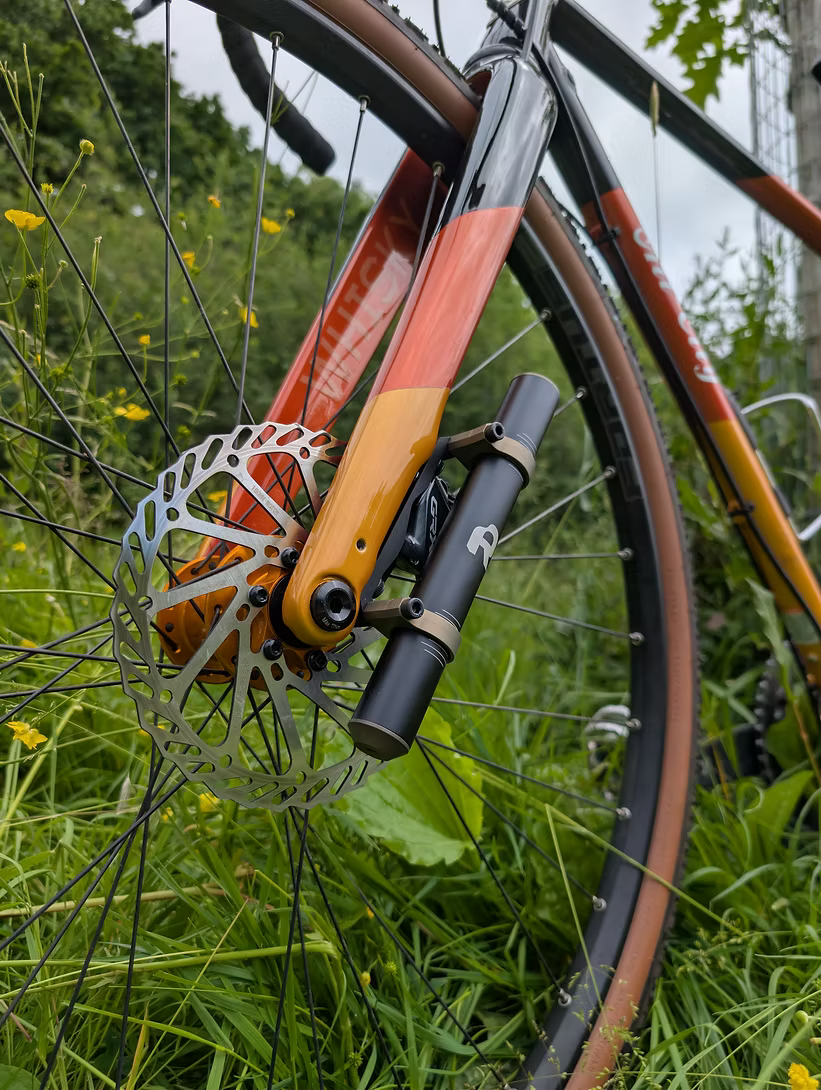
- Out of sight, not out of mind. Securely mounts low and out of the way by replacing the flat mount brake adapter on your fork: no interfering with your cockpit setup.
- Easy Setup, No Uncertainty. Designed to excel over varied terrain, no set up or adjustment required.
Compatibility:
Designed for use only forks with a flatmount brake fitment. suitable for use with 140mm or 160mm rotors.
For gravel suspension forks we reccommend using the standard TMD v2.
SPECIFICATION:
- Unit weight: 450 g
- no other setup in necessary
FAQ:
How do I know if this will fit my bike?
The mount is designed to replace a flat mount brake adaptor for 140mm or 160mm rotors.
Do I need to adjust my tyre pressure when using TMD?
No, just plug and play.
Can I use this on my suspension gravel fork?
For suspension forks we recommend using the standard steerer mounted TMD v2.
What tools do I need to install this?
Installation is simple, needing only a 4mm allen key and possibly a T25 to swap the flatmount bracket out.
Review of TMD for suspension fork
THEORY BEHIND TMD - SHOCK ABSORBERS
A commonly used device that reduces the amplitude and duration of vibrations in a larger system or structure.
Examples:
- Buildings and large structures, where earthquakes can cause damage.
- In precision instruments, where rotating motors and cutting forces can reduce accuracy.
- In spacecraft and rockets, where strong winds can create turbulence and shake the structure on the launch pad.
- In ships, to reduce the effects of sea swell.
- And a well-known application in Formula 1 cars to control front-end bounce when hitting curbs at the apex of turns.
- Simply put, TMD for bicycles reduces fatigue and increases confidence.
The design and construction of TMD for mountain bikes presents a number of challenges.
“Traditional” TMD is tuned to a specific target frequency with the goal of restoring the system in which it is installed to its natural frequency. However, given the wide range of frequencies and amplitudes at play in MTB riding—caused by changes in terrain, rider input, and suspension dynamics—choosing a fixed frequency means that the TMD operates outside its ideal operating window during use.
During development, we found that even when focused on a single frequency, the unit provides noticeable benefits based on data from the accelerometer and rider feedback.
We realized two things:
Mass can move freely, and when that happens, its momentum is temporarily stored in one of the two springs that resist it. When the input force is transferred to the wheel, this energy transfer evens out over time, thereby reducing the compression spikes that riders feel on uneven sections of the trail. This accumulation and return of energy reduces unpleasant feedback by smoothing out the time it takes for the rider to feel the full input force, which is perceived as a reduction in vibrations. The benefits of this solution are evident in increased front-end grip, chassis stability, reduced mental and physical fatigue, and less arm fatigue during longer rides.
The second finding was that the data we recorded for static mass in the head tube offered an advantage over a situation where no additional mass was added to the bike, and that TMD again provided a similar performance increase compared to additional mass. It was the “active” component of TMD that made it more effective. The static mass was able to offset some of the input forces—for the same reason that moving a heavy object requires more force than moving a lighter one—but not as effectively as the same mass within the TMD design. The TMD functioned as “mass with a mechanical advantage,” as we termed it.
While we acknowledge that this means the system is not a “true” tuned shock absorber in the strict sense, its actual performance benefits speak for themselves and offer riders a smoother, more controlled ride. We set out to design a tuned shock absorber and ended up with something unexpected—but better than we had anticipated.
Rimpact is a Bristol-based company founded in 2018 by Matt Shearn—it was born out of a simple need for better bike components. Frustrated by the available options, Matt designed his own insoles for his bike and soon after sparked interest among friends and other riders, which led to the founding of Rimpact.
Since then, we have expanded our product line to include chain guides for all types of mountain bikes. Building on this success, we have also developed the Chain Damper and TMD—projects we have been quietly working on in our workshop for several years.
We’re still a small team of two, and every product we sell is either manufactured or assembled by us right here at our Bristol facility, where it’s put together with the same care and precision we demand for our own rides.